

Buggy or 4x4 Safari: Which to Choose in the Dominican Republic?
Exploring the Dominican countryside beyond the resort strip usually comes down to one of two formats: a buggy tour, where you drive yourself, or a 4×4 safari truck tour, where a professional driver takes the group along for the ride. Both cover similar terrain — sugar cane fields, rural roads, small villages — but the actual experience of the day differs quite a bit depending on which one you choose. Before booking, it helps to understand what each format actually involves, since the right pick depends less on the destination and more on who’s in your group and what kind of day you’re after.
Two Different Ways to Explore the Backcountry
A buggy tour puts you behind the wheel. Buggies are small, open, off-road vehicles, usually driven in pairs, with one person driving and a passenger alongside. The appeal is hands-on: navigating dirt tracks, sugar cane fields and rural roads directly, with the driving itself as much a part of the experience as the scenery passed along the way. Reviews of buggy tours in the region consistently mention mud, bumps and a genuinely active few hours behind the wheel — it’s a format built around participation rather than observation, and it tends to leave a strong impression precisely because of that physical involvement.
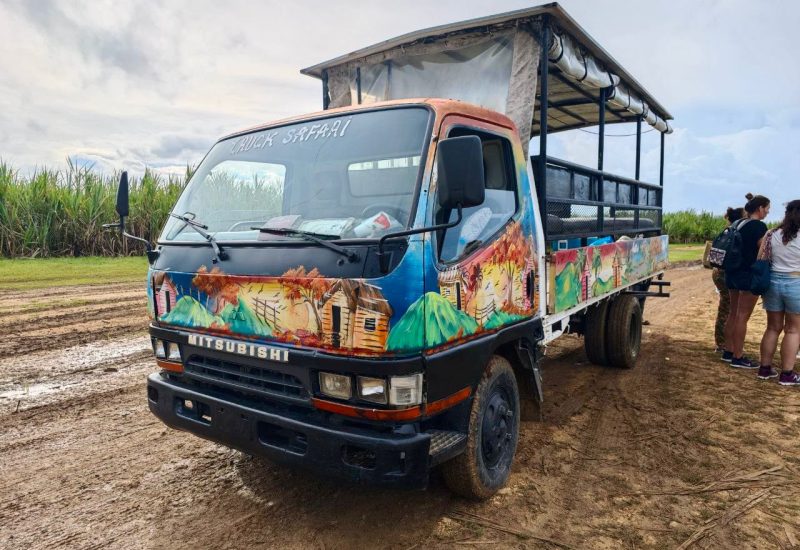
A 4×4 safari truck tour flips that around. These are larger, open-sided trucks that carry a group of passengers together, driven by a professional guide rather than the guests themselves. Nobody in the group needs to drive, which removes the need for a license and opens the format to a wider range of travelers, including those who can’t or don’t want to operate a vehicle themselves. Safari trucks are also frequently used as the connecting transport between stops on a broader itinerary — shuttling a group between a village visit, a cave or a farm stop — in addition to standing as an excursion format in their own right. In many cases, the same day out will actually combine both: a safari truck for the transfer portions, and buggies or quads for the off-road driving sections themselves.
Understanding this distinction early makes the rest of the decision much simpler, since most of what follows traces back to this one difference: who is doing the driving, and how much of the day is spent behind the wheel versus riding along.
What Each Format Means for Driving and Comfort
The practical differences between the two formats come down mostly to who’s in control and how physically involved the day becomes.
With a buggy, the driver needs a valid driver’s license, and typically must be an adult, with passengers accepted from a certain minimum age depending on the operator. Expect to get dusty in the dry season or muddy in the rainy season — multiple tour reviews specifically describe returning “absolutely covered in mud” as part of the fun rather than an unfortunate side effect. The ride is bumpier and more physically active, since the driver is directly handling the vehicle over uneven terrain rather than sitting back and watching the scenery go by. It also means constant attention: potholes, narrow trail sections and other vehicles in the group all require active navigation rather than passive enjoyment.
A safari truck ride is considerably more comfortable in a conventional sense: passengers sit in the open truck bed or on bench seating, exposed to the outdoor air and views but not the physical task of driving. There’s no mud to worry about, no license required, and the pace of the day is set entirely by the driver and guide rather than each individual behind a wheel. The trade-off is that the experience leans toward sightseeing rather than participation — travelers see the same countryside, but from the passenger’s seat rather than the driver’s. For some, that’s a plus rather than a downside, particularly on a hot day when not having to focus on driving leaves more attention free for the landscape and the guide’s commentary.
The Type of Traveler Who Prefers Each Option
- Buggy tours tend to draw travelers looking for an active, hands-on adventure: couples and groups of friends who want the driving itself to be part of the thrill, and who don’t mind getting dirty or dealing with a genuinely bumpy ride. They require a valid license for whoever’s driving, and most operators set a minimum age for passengers, which can rule out very young children.
- 4×4 safari trucks tend to suit families with young children, older travelers, or anyone traveling with someone who has mobility considerations or simply doesn’t want to drive. Because a professional driver handles the vehicle, there’s no license requirement for the group, and multiple travelers can share the same seat without needing to split into driver-and-passenger pairs the way a buggy requires.
- Larger groups in general tend to fit more naturally into a safari truck, since one vehicle can carry considerably more passengers than a pair of buggies, while buggy tours work well for smaller groups who specifically want the driving experience for its own sake.
- Solo travelers or couples without a strong preference either way often find that the choice comes down to appetite for physical activity that day — a buggy after a heavy lunch is a different proposition than one first thing in the morning.
Our Recommendation Based on Your Group
- A couple or small group of friends wanting an active day: choose the buggy. The driving itself is the main draw, and the format rewards travelers who don’t mind mud, bumps and a bit of physical effort.
- A family with young children: lean toward the safari truck, since there’s no license requirement, no driving skill involved, and typically a more relaxed pace suited to children who can’t drive a buggy themselves.
- A larger group or multi-generational trip: the safari truck again tends to work better logistically, letting everyone travel together rather than splitting into buggy pairs.
- Anyone without a valid driver’s license, or unwilling to drive on rough terrain: the safari truck removes that requirement entirely, while a buggy tour makes it a precondition for at least one person in each pair.
- A group that wants a bit of both: many itineraries already combine the two — a safari truck for transfers, buggies or quads for the off-road segments — worth asking about if your group has mixed preferences.
FAQ
Do I need a license to drive a buggy?
Yes, a valid driver’s license is generally required for whoever drives the buggy, even though it isn’t always checked on-site. Passengers don’t need one.
Is a safari truck less exciting than a buggy?
It’s a different kind of experience rather than a lesser one — less physically active and hands-on, but often more comfortable and better suited for sightseeing, group bonding, and travelers who’d rather not drive over rough terrain themselves.
Can children ride in a buggy?
Most operators set a minimum age for buggy passengers, and require an adult driver. A safari truck typically has fewer restrictions, since no one in the group needs to drive.
Will I get muddy on a buggy tour?
Very likely, especially during the rainy season — it’s a well-documented and often celebrated part of the experience rather than something tours try to avoid.
Are safari trucks used for anything besides sightseeing?
Yes — safari trucks are frequently used as the shuttle vehicle connecting different stops on a larger day itinerary, in addition to serving as a stand-alone excursion format.
Final Thoughts
Buggy and 4×4 safari truck tours cover much of the same Dominican countryside, but they deliver genuinely different days: one built around the driving itself, the other built around riding along and taking in the scenery as a group. Neither format is better in absolute terms — the right choice comes down to who’s in the group, whether everyone can and wants to drive, and whether the appeal is the hands-on adventure or the shared, more relaxed ride.
Operators running countryside excursions from Bayahibe, Quetzal Excursions included, generally rely on the buggy format as their core backcountry experience, with a safari truck typically used to transfer guests to and from the starting point of the adventure — a combination that reflects how naturally the two formats complement each other on a single day out.

Who are we?
Based in Bayahibe, Quetzal Excursions is a local agency specialized in small-group sea trips to Saona, Catalina, and the most beautiful hidden gems of the Dominican Republic. We focus on comfort, safety, and authenticity, aboard high-end boats with a professional crew.
📱 CONTACT US ON WHATSAPP : +1 (809) 979-7359

Our Regular Excursions
Saona by Catamaran – All Comfort
Our Excursion to Catalina Island
Snorkeling Tour to Catalina
Our Private Excursions
Private rental of the Quetzal catamaran
📌 Need help planning your excursion?
Contact Quetzal Excursions to plan your activities from your place of stay, with included transport, small group, professional guide, and high-end services.