

How long does a whale watching excursion last?
Duration of a whale watching excursion: travel time and time on the water
Anyone planning a whale watching day in the Dominican Republic eventually asks the same practical question: how long will it take? The answer matters more than it seems, because the excursion is not just a boat ride. It is a full day, with a long road journey, a stretch on the water, meals and a return trip, and the length of each part depends on where you start and on factors nobody controls, such as traffic, sea conditions and the whales themselves.
This article explains what makes up the length of a whale watching day, how much of it is usually spent actually looking for whales, what can lengthen or shorten the outing, how to prepare for a long day and which questions are worth asking before booking. Near the end, it summarizes what Quetzal Excursions says on its official page about its own whale watching excursion, including the points where that information is incomplete.
Two things are worth saying up front. First, the exact timetable varies from one operator and one day to the next, so no article can give a reliable hour-by-hour schedule. Second, a longer day is not a worse day: much of the time goes into getting to the right place and doing it comfortably.
Why whale watching in the Dominican Republic means a long day
Humpback whales travel thousands of kilometers each year from cold feeding waters in the North Atlantic to warm Caribbean waters, where they mate, give birth and nurse their calves. In the Dominican Republic, the best-known gathering place is the Bay of Samaná, on the northeast coast, which is why most whale watching takes place there. The season is limited and generally runs from mid-January to the end of March.
For travelers staying in the east, around Punta Cana or Bayahibe, this means traveling to another part of the country. The road portion is substantial, and it is the main reason a whale watching outing is a full-day commitment rather than a half-day activity.
The parts of the day
Although every operator organizes things in its own way, a whale watching day is usually made up of the same building blocks:
Early pickup and the road journey. The day starts early, often at dawn or shortly after, with a transfer from the hotel. This is the longest single part of the day and varies with the starting point and with traffic.
A breakfast or rest stop. Many outings include a pause on the way, which breaks up the journey and gives time to eat before boarding.
Time on the water. This is the heart of the excursion: the boat leaves the dock, heads into the bay and looks for whales. Time at sea is usually counted in a few hours, not a full day.
Lunch. A meal is often part of the program, either before or after the boat trip.
Other stops. Some outings add a scenic viewpoint or a short activity, which extends the day.
The return journey. The road back is as long as the road out, and often feels longer after a full day outdoors.
The order and content of these blocks vary, but together they explain why the whole thing usually takes most of a day.
How much of the day is actually spent watching whales
This is the point that surprises many first-timers. Time on the water is only a fraction of the total, and the time spent right next to whales is a fraction of that. A boat first has to find the animals, which takes time and depends on where they are that day. Once a group is located, regulations typically govern how close boats may approach and for how long they may stay, in order to limit disturbance.
In other words, a day of around ten hours does not mean ten hours with whales. The observation time is usually a couple of hours, sometimes a little more, sometimes less, depending on how the day unfolds. Knowing this beforehand sets realistic expectations and avoids disappointment.
What makes the duration vary
Several factors can lengthen or shorten a whale watching outing:
- Your starting point. A hotel closer to the departure area means a shorter transfer than one farther away.
- Traffic and road conditions, which can add time in either direction.
- Sea conditions. Rough water may slow the boat or change the plan.
- Whale activity. Finding animals quickly shortens the search, while a quiet day lengthens it.
- Regulations and the number of boats. The rules about approaching whales apply to everyone, and busy days can mean waiting your turn.
- Meals and additional stops, which add to the program.
- The group. A larger group or one with young children may move more slowly.
Because of this, any stated duration is approximate. The most useful figure is the one given by the operator for your specific departure point.
Why no one can promise an exact hour-by-hour schedule
It is tempting to look for a precise timetable: pickup at one hour, boat at another, lunch at a third. The reality is that most of the moments in the day depend on things nobody controls. Traffic on the road, the state of the sea, the location of the whales and the pace of the group all move the clock.
Operators usually publish approximate times for pickup and sometimes for the return, and those are the ones to rely on. An hour-by-hour breakdown, if one is given, should be read as an estimate, not a commitment. It is more useful to ask what time you will be collected, roughly how long you will spend on the water and what time the return is expected than to expect a fixed schedule.
Preparing for a long day
A full day outdoors is easier with a little preparation:
- Dress in layers. It can be cool in the early morning and on the water, and hot at midday.
- Bring sun protection: hat, sunglasses and sunscreen, preferably a mineral one.
- Consider seasickness. The bay can have a swell, and anyone prone to motion sickness should take medication in advance, as directed.
- Pack water and light snacks, even if meals are provided.
- Bring a jacket or windbreaker for the boat.
- Charge your phone and camera, and bring a waterproof cover if you have one.
- Wear comfortable, non-slip shoes.
For children, it also helps to bring something to keep them occupied during the road journey, which is often the hardest part.
Planning the days around the excursion
Because the outing takes most of a day and starts early, it works best when the days around it are planned with that in mind. An early night beforehand makes the dawn start more bearable, and leaving the following morning free avoids rushing after a long day.
It is also wise not to schedule other commitments for the evening of the excursion, such as a late reservation or a flight, since the return time can vary. Travelers staying only a few days may prefer to place the outing at the start of the stay, so that any weather-related change can still be accommodated.
What you may see on the water
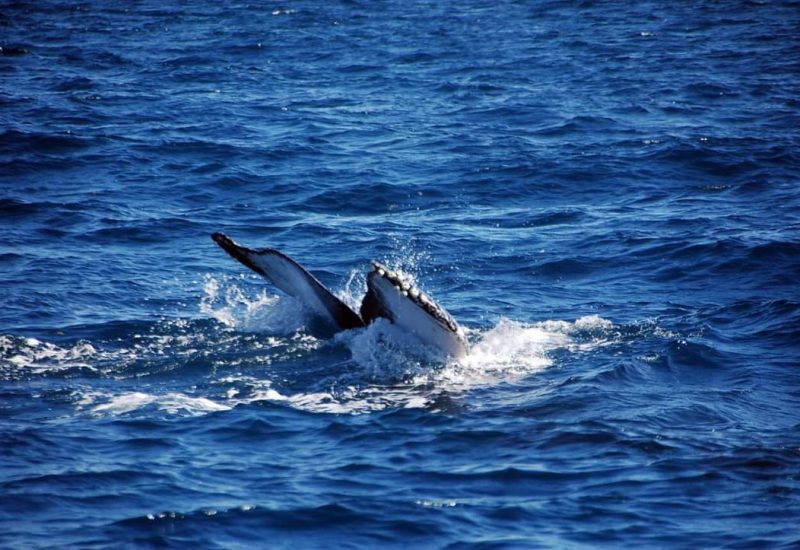
Although nothing is guaranteed, humpback whales in the bay are known for behaviors that can make the time on the water memorable. Observers sometimes see whales surfacing to breathe, slapping the surface with their tails or fins, leaping partly or fully out of the water or raising their heads to look around. Mothers with calves are also a feature of the season, and groups of males sometimes compete around a female.
None of these behaviors can be predicted, and some days are calmer than others. The point is that time on the water is rarely uneventful, even when the whales are not performing, because the bay itself, the coastline and the sea life are part of the experience.
Whale watching responsibly
Whales are wild animals, and a good outing keeps disturbance to a minimum. Boats are expected to keep a respectful distance, approach slowly, avoid cutting across the path of animals and limit the time spent with each group. Passengers help by staying calm, keeping noise down and following the crew’s instructions, and by never throwing anything into the water.
Choosing an operator that follows the rules and explains them is part of this. It is reasonable to ask how the boat approaches whales and how long it stays with a group, and a serious operator will have clear answers.
Questions to ask before booking
Since the duration varies so much, a few direct questions give the most useful information:
- What time is pickup from my hotel, and what time is the expected return?
- How long is spent on the water, as opposed to traveling?
- Which meals are included, and where are they taken?
- Are there other stops in the program?
- What is the maximum group size on the boat?
- What is the policy if no whales are seen or if the weather is poor?
- In what language does the guide speak?
Clear answers to these questions make the day much easier to plan.
What Quetzal Excursions says about its whale watching excursion
According to its official page, Quetzal Excursions offers a whale watching excursion in the Bay of Samaná during the season, from 15 January to 30 March. The day is described as lasting about ten hours, with hotel pickup from Bayahibe and Punta Cana, a breakfast stop, two to three hours on a motorized catamaran carrying up to 40 people, a Spanish-speaking guide, lunch, and a visit to Montaña Redonda by safari truck. The page states that sightings are not guaranteed and recommends the excursion from age six.
The information on the page is not fully consistent: some details, such as the exact pickup times, the return time and the place where breakfast and boarding take place, are described differently in different places. For that reason, no hour-by-hour timetable is given here. To know the precise schedule for your hotel, the safest approach is to ask Quetzal Excursions directly when booking. Dates, times and conditions may change from one season to the next.
Final Thoughts
A whale watching excursion in the Dominican Republic is a full-day outing, typically around ten hours when it includes the road journey from the east coast. Only a part of that time, a few hours, is spent on the water, and an even smaller part is spent close to whales, which is why expectations matter.
The length of the day depends on where you start, on traffic, on the sea and on the whales, so any schedule is approximate. The best preparation is practical: dress for changing conditions, plan for seasickness, leave the days around the excursion free and ask the operator for the pickup time, the time on the water and the expected return. With that done, the length of the day stops being a worry and becomes simply the cost of seeing one of the most remarkable animals in the Caribbean.

Who are we?
Based in Bayahibe, Quetzal Excursions is a local agency specialized in small-group sea trips to Saona, Catalina, and the most beautiful hidden gems of the Dominican Republic. We focus on comfort, safety, and authenticity, aboard high-end boats with a professional crew.
📱 CONTACT US ON WHATSAPP : +1 (809) 979-7359

Our Regular Excursions
Saona by Catamaran – All Comfort
Our Excursion to Catalina Island
Snorkeling Tour to Catalina
Our Private Excursions
Private rental of the Quetzal catamaran
📌 Need help planning your excursion?
Contact Quetzal Excursions to plan your activities from your place of stay, with included transport, small group, professional guide, and high-end services.